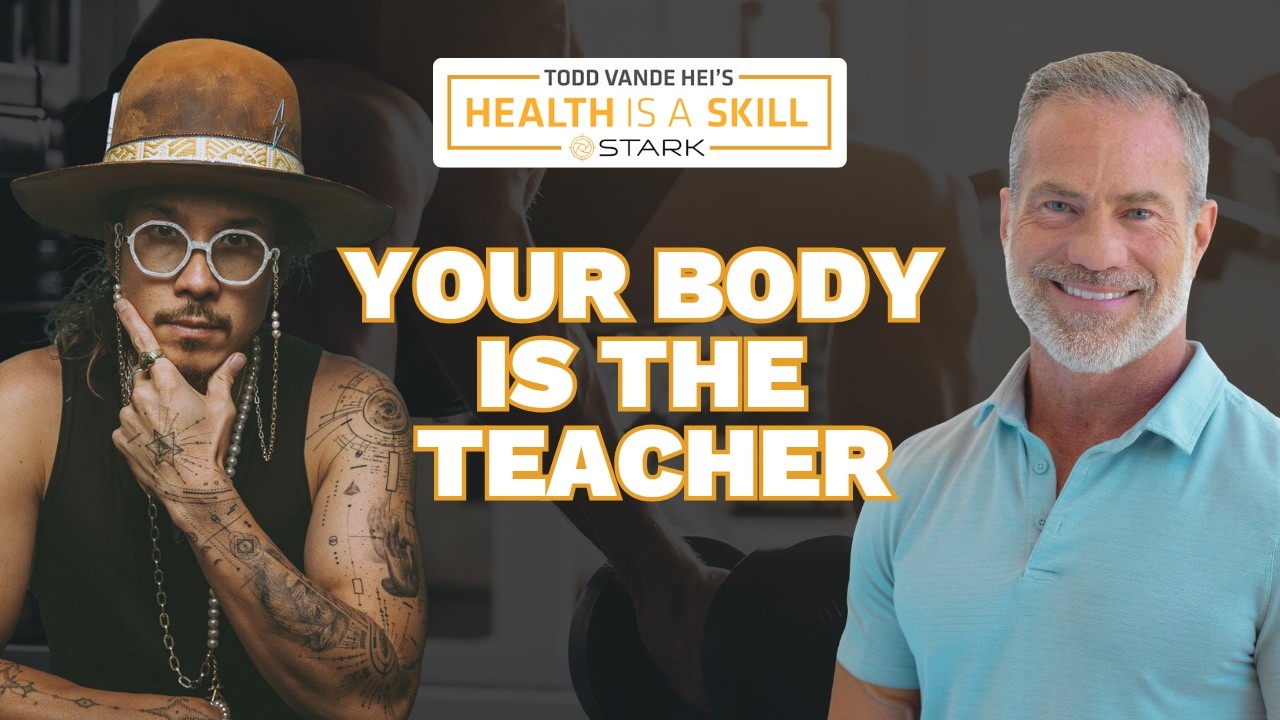
Nick Onken spent 20 years at the top of commercial photography — Nike, Coca-Cola, GQ, Vogue, Justin Bieber, Tony Robbins, Tom Hanks. He traveled to 60+ countries and built the kind of career most creatives would call the finish line. Then chronic fatigue hit. Brain fog. No creative spark. The pace that built everything was quietly taking everything away. His reset didn't come from a productivity system or a new supplement. It came from a month in Wudang Mountain, China — the birthplace of Daoist martial arts — training kung fu six hours a day with a master who told him on day one to slow down.
The Problem With Going Fast
High performers are conditioned through a relentless feedback loop: do something hard, accomplish it fast, get the reward, repeat. Speed becomes identity. Slowing down feels like failure. The business leaders I work with at Stark in Newport Beach carry this pattern in their bodies. They move quickly through everything — including their own health. They ignore signals. They sprint through the transitions between phases of life instead of using them. They treat recovery like weakness.
Nick's kung fu master gave him a framework that cuts through all of that. The word "kung fu" doesn't actually mean the martial art — it means repetition until mastery. Anything can be kung fu. But the pathway to mastery isn't speed. It's presence. When you go too fast, your muscles don't capture the movement. The motor pattern doesn't form properly. You practice the wrong thing at high intensity and call it progress.
His master told him to take the hands out of the movement entirely. Just learn the legs. Get that down. Then add the hands. One layer at a time, at your own pace — not the pace of the person who's been doing it for three weeks.
"The Body Learns at the Speed of Honesty, Not Ambition"
That line is Nick's most-quoted. Here's what it means in practice: most high performers are performing a version of themselves that's optimized for external validation. The ambition is real, but it's often running on a story — prove something to a parent, earn love that was conditional, outrun an old identity. The drive is the drive. But it's not honest feedback from your body. It's noise.
Slowing down forces honesty. You find out where you're actually tight. Where you're actually weak. Where you've been compensating for years and didn't notice because the compensation was working well enough. In kung fu, this showed up as Nick's right side — years of camera work had wound his whole right side into tension he'd never noticed. He noticed it in Wudang because he couldn't do the movements correctly, no matter how hard he tried to muscle through it. The solution wasn't to try harder. It was to slow down and feel where the block was.
I've had that exact conversation with business leaders at Stark. Their labs look fine — until we run the full panel. Their energy is "fine" — until we compare it to what it was five years ago. They don't feel the drift because they've been compensating for it. The body doesn't tell you directly. It tells you indirectly: through performance ceilings, through recovery that takes longer, through sleep that stopped being restorative at some point they can't quite place.
What the Body Has to Say
Nick's point — that your body is a teacher — lands differently when you've been living from the neck up. Business leaders are extraordinary at cognitive performance. They are often remarkably bad at reading their own physical state. The business leaders I see who are aging the fastest are the ones whose body had a lot to say and they weren't listening. They weren't ignoring it on purpose. They just didn't have a system for hearing it.
Body composition is the starting point. Not because aesthetics matter, but because body composition is a visible, measurable output of what's happening hormonally, metabolically, and behaviorally. Pain is the next signal — where it shows up in the body maps to what's out of alignment. Then nervous system load: if you're waking up at 3 a.m. with your mind going, your cortisol timing is off. If you can't recover between workouts, your hormones or nutrition are failing you.
Key Takeaways
- "Kung fu" means repetition until mastery — the path to mastery is presence, not speed
- High performers compensate for physical dysfunction so well they stop noticing it — until performance ceilings appear and recovery gets harder
- "The body learns at the speed of honesty, not ambition" — slowing down reveals what going fast was hiding
- Kung fu burns 1.5–2x more calories than equivalent training time due to the constant compound movement and asymmetric motor demands — Nick lost 14 lbs in one month
- The research on Tai Chi, Qi Gong, and kung fu shows measurable protection against Alzheimer's and dementia — the brain's constant bilateral switching is neurologically protective
Nick came back from China training six days a week, having lost 12–14 pounds, with his right side unlocking for the first time in years. His metabolism was running so hot his Doctor told him to eat more. He'd found a practice that was simultaneously strength training, brain training, metabolic training, and meditative training — in about an hour a day. The most time-efficient thing he'd ever done for his health was the one that required the most patience.
That's the counterintuitive truth most business leaders never get to. Your outer performance can only be as strong as your inner alignment. You've optimized everything in your business. Your health is the one thing you haven't figured out yet. Slowing down long enough to actually assess it is where it starts.
Health is a skill. And sometimes the move is to stop sprinting through it.
Stop Compensating — Start Measuring
The Stark Baseline gives business leaders in Newport Beach and Orange County a full Doctor-led picture of where their body actually stands — hormones, body composition, recovery capacity, and more. No guessing. No reassurance. Just data.
Book Your Stark BaselineServing Newport Beach (92660) & Tustin/Irvine (92782) · Doctor-led · personal training · health optimization